Flowering plants, or angiosperms, dominate the terrestrial landscape, showcasing an extraordinary diversity of form and function. This success is rooted in their complex structural organisation—a hierarchical system ranging from cells and tissues to specialised organs. Understanding this organisation is key to botany, agriculture, and horticulture. This article provides a detailed exploration of the structural plan of flowering plants, covering morphology, tissues, anatomy, and reproductive structures.
1. Morphology and Modifications
Morphology is the study of the external form and structure of plants. A typical flowering plant (sporophyte) is differentiated into two main systems:
- The Root System: Underground (usually), responsible for anchorage, absorption, and storage.
- The Shoot System: Above ground, comprising stems, leaves, flowers, and fruits.
Modifications are structural alterations that enable plants to adapt to specific environments and functions:
- Root Modifications: For storage (taproots in carrot, adventitious in sweet potato), support (prop roots in banyan, stilt roots in maize), and special functions like respiration (pneumatophores in mangroves).
- Stem Modifications: Can be underground (rhizome in ginger, tuber in potato, bulb in onion, corm in colocasia) for food storage and perennation, or above ground (tendrils in cucumber for climbing, phylloclade in Opuntia for photosynthesis).
- Leaf Modifications: Into tendrils (pea) for climbing, spines (cactus) for defence, and fleshy leaves (onion) for storage.
2. Tissues: The Building Blocks
Tissues are groups of cells with common origin and function. Plant tissues are broadly classified into Meristematic and Permanent tissues.
A. Meristematic Tissue: Composed of actively dividing cells, found in regions of growth.
- Apical Meristem: At root and shoot tips, responsible for primary growth (increase in length).
- Lateral Meristem: (Vascular cambium, cork cambium) responsible for secondary growth (increase in girth).
- Intercalary Meristem: Located at internodes or leaf bases (grasses), allowing rapid regeneration.
B. Permanent Tissue: Differentiated cells that have lost dividing ability. They are simple (one cell type) or complex (multiple cell types).
- Simple Permanent Tissues:
- Parenchyma: Living, thin-walled, for storage, photosynthesis (chlorenchyma), and gas exchange (aerenchyma).
- Collenchyma: Living, unevenly thickened walls, provide mechanical support to growing stems and leaves.
- Sclerenchyma: Dead at maturity, thick lignified walls, provide rigid support (fibres and sclereids).
- Complex Permanent Tissues (Vascular Tissues): Conduct water, minerals, and food.
- Xylem: Conducts water and minerals upwards. Comprises tracheids, vessels, xylem parenchyma, and xylem fibres. Vessels are the main conducting element in angiosperms.
- Phloem: Conducts organic food (sucrose) bidirectionally. Comprises sieve tube elements (with companion cells), phloem parenchyma, and phloem fibres.
3. Anatomy and Functions of Root
Anatomy refers to the study of internal tissue organisation.
- Dicot Root (Primary): Outermost epidermis with root hairs for absorption. Central ground tissue (cortex) is parenchymatous, ending at the innermost endodermis (with Casparian strips regulating material entry). The pericycle (just inside endodermis) is the site for lateral root initiation. The vascular bundle is radial (xylem and phloem on alternate radii), often with exarch xylem (protoxylem outward). The centre may have pith.
- Monocot Root: Similar to dicot but with a large, prominent parenchymatous pith. Vascular bundles are numerous (polyarch).
- Functions: Anchorage, absorption of water/minerals, storage, and in some cases, vegetative propagation.
4. Anatomy and Functions of Stem
- Dicot Stem (Primary): Outer epidermis with cuticle. Cortex differentiated into hypodermis (collenchyma), cortical parenchyma, and an inner endodermis (starch sheath). The vascular bundles are arranged in a ring (eustele), are conjoint, collateral, and open (with cambium), allowing for secondary growth. The centre is occupied by a large pith.
- Monocot Stem: Vascular bundles are scattered in ground parenchyma (atactostele), are conjoint and closed (no cambium). Each bundle is surrounded by a sclerenchymatous bundle sheath. No clear differentiation of cortex and pith.
- Functions: Support, transport of materials, storage, photosynthesis (green stems), and bearing leaves, flowers, and fruits.
5. Anatomy and Functions of Leaf
The leaf is a lateral outgrowth specialised for photosynthesis. Its internal structure is optimised for light absorption and gas exchange.
- Dorsiventral Leaf (Dicot): Upper epidermis has a thicker cuticle. Mesophyll is differentiated into palisade parenchyma (upper, tightly packed for photosynthesis) and spongy parenchyma (lower, with air spaces for gas exchange). Vascular bundles form the veins, with the midrib being the largest. Bundle sheath cells may surround them. Stomata are more abundant on the lower epidermis.
- Isobilateral Leaf (Monocot): Both epidermal layers are similar. Mesophyll is undifferentiated. Vascular bundles are similar, with larger bundles having sclerenchymatous sheaths. Stomata are present on both surfaces.
- Functions: Photosynthesis, transpiration, and gas exchange.
6. Inflorescence: Cymose and Racemose
The arrangement of flowers on the floral axis is called inflorescence.
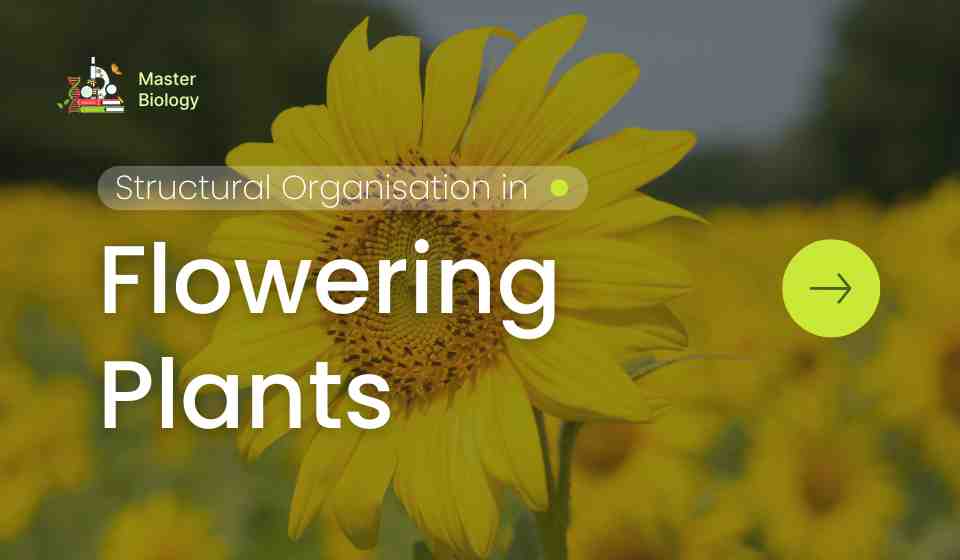
- Racemose (Indeterminate): The main axis continues to grow, flowers are borne laterally in acropetal succession (older at base, younger at apex). Types: raceme (mustard), spike (Achyranthes), corymb (candytuft), umbel (onion), capitulum (sunflower), catkin (oak).
- Cymose (Determinate): The main axis terminates in a flower, growth is continued by lateral axes. Flowers open in basipetal succession (older at apex, younger at base). Types: monochasium (solitary in Nerium), dichasium (false cyme in Dianthus).
7. Structure of Flower
The flower is the reproductive unit. A typical flower has four whorls:
- Calyx: Outermost, sepals (usually green), protective.
- Corolla: Petals, often colourful and scented, attract pollinators.
- Androecium: Male reproductive part, consists of stamens. Each stamen has a filament and an anther. The anther produces pollen grains (male gametophyte).
- Gynoecium (Pistil): Female reproductive part, consists of one or more carpels. Each carpel has an ovary (containing ovules), a style, and a stigma (for pollen reception). The ovule houses the embryo sac (female gametophyte).
8. Fruit and Seed
- Fruit: A mature, ripened ovary developed after fertilisation. The ovary wall becomes the pericarp (may be fleshy as in mango, or dry as in groundnut). Fruits protect seeds and aid in their dispersal. True fruits develop from the ovary (e.g., tomato), while false fruits involve other floral parts (e.g., apple – thalamus).
- Seed: A mature, fertilised ovule. It consists of:
- Seed coat: Protective outer covering.
- Embryo: The future plant, with radicle (embryonic root), plumule (embryonic shoot), and cotyledon(s) (seed leaves). Monocots have one cotyledon (scutellum in grasses), dicots have two.
- Endosperm: Nutritive tissue for the developing embryo (present in monocots like maize, absent in mature dicot seeds like pea, where food is stored in cotyledons).
Conclusion
The structural organisation in flowering plants represents a magnificent evolutionary adaptation. From the cellular precision of tissues to the specialised architecture of roots, stems, and leaves, and finally to the sophisticated reproductive systems of flowers, fruits, and seeds, each level of organisation is intricately linked to the plant’s survival and propagation. This hierarchy not only underpins the biological success of angiosperms but also forms the fundamental basis for human agricultural practices and ecological understanding.