Chapter overview: plant anatomy
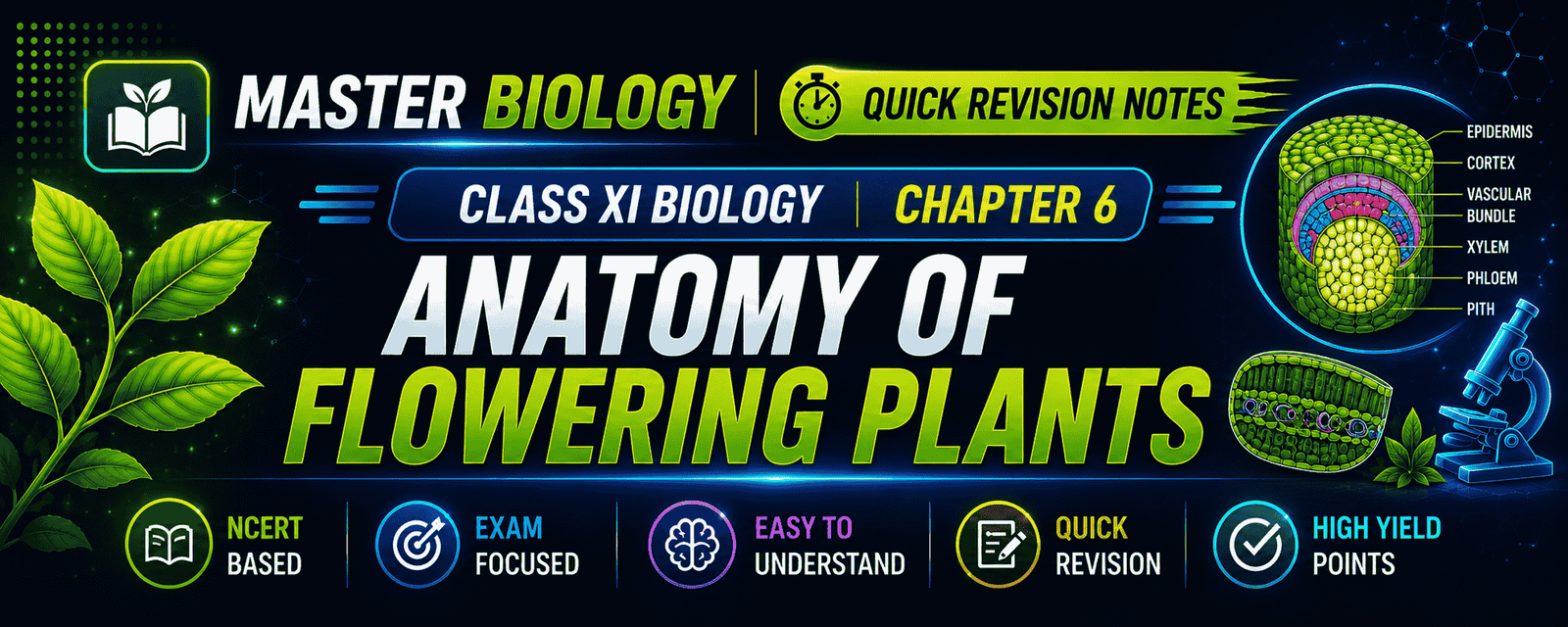
Plant anatomy is the study of internal structure and functional organisation. Cells form tissues, tissues form organs, and dicots and monocots show important anatomical differences. Internal structures also reveal adaptations to habitat.
6.1 Tissue systems
Based on structure and location, flowering plants have three tissue systems: epidermal, ground/fundamental and vascular/conducting.
Epidermal tissue system
The epidermis is the outermost, generally single-layered protective covering. It has compact parenchymatous cells, often covered by cuticle to reduce water loss; cuticle is absent in roots. Stomata regulate transpiration and gaseous exchange. A stoma has two guard cells surrounding a pore: guard cells are bean-shaped in dicots and dumb-bell-shaped in grasses.
Root hairs are unicellular epidermal extensions that absorb water and minerals. Shoot epidermal hairs are trichomes, usually multicellular; they reduce transpiration and may be branched, unbranched or secretory.
Ground tissue system
All tissues except epidermis and vascular bundles form ground tissue. It includes parenchyma, collenchyma and sclerenchyma; in leaves, chloroplast-containing ground tissue is called mesophyll.
Vascular tissue system
Xylem and phloem together make vascular bundles. In dicot stems, cambium lies between phloem and xylem, so bundles are open and can form secondary xylem and phloem. In monocot stems, cambium is absent, so bundles are closed.
| Arrangement | Meaning / occurrence |
|---|---|
| Radial | Xylem and phloem alternate on different radii; characteristic of roots |
| Conjoint | Xylem and phloem lie together on the same radius; common in stems and leaves |
| Open | Cambium present; secondary growth possible; dicot stem |
| Closed | Cambium absent; secondary growth absent; monocot stem |
6.2 Root anatomy: dicot versus monocot
Both roots have epidermis/epiblema, cortex, endodermis, pericycle, vascular bundles and pith. The endodermis has Casparian strips: suberin deposits in radial and tangential walls. The pericycle initiates lateral roots and vascular cambium during secondary growth.
| Feature | Dicot root | Monocot root |
|---|---|---|
| Xylem bundles | Usually 2-4 | More than six (polyarch) |
| Pith | Small or inconspicuous | Large and well developed |
| Secondary growth | Occurs after cambium formation | Absent |
| Vascular arrangement | Radial; xylem and phloem alternate | |
Stem anatomy: dicot versus monocot
| Feature | Dicot stem | Monocot stem |
|---|---|---|
| Hypodermis | Collenchymatous | Sclerenchymatous |
| Ground tissue | Cortex, endodermis/starch sheath, pericycle, medullary rays and pith distinct | Large, undifferentiated parenchymatous ground tissue |
| Vascular bundles | In a ring; conjoint, open and endarch | Scattered; conjoint and closed; bundle sheath present |
| Phloem parenchyma | Present | Absent |
| Water cavities | Absent | Present within vascular bundles |
In a dicot stem, the endodermis is called the starch sheath because it contains starch grains. Pericycle occurs as semi-lunar sclerenchymatous patches above phloem. In a monocot stem, peripheral bundles are generally smaller than central bundles.
Leaf anatomy: dorsiventral versus isobilateral
A leaf has epidermis, mesophyll and vascular system. Vascular bundles in veins and midrib are surrounded by thick-walled bundle sheath cells.
| Feature | Dorsiventral (dicot) leaf | Isobilateral (monocot) leaf |
|---|---|---|
| Stomata | Generally more on lower/abaxial epidermis | Present on both surfaces |
| Mesophyll | Differentiated into upper palisade and lower spongy parenchyma | Not differentiated into palisade and spongy tissue |
| Venation / bundles | Reticulate; bundles vary in size | Parallel; bundles nearly similar in size |
| Special feature | Palisade cells vertically arranged, compact and chloroplast-rich | Bulliform cells in grasses cause leaf rolling under water stress |
NCERT revision prompts
- Name the three tissue systems and their major components.
- Describe the stomatal apparatus and functions of trichomes.
- Differentiate open and closed vascular bundles.
- Compare dicot and monocot roots, stems and leaves.
- Why do monocot roots not undergo secondary growth?
- What are Casparian strips and bulliform cells?
- How can a transverse section identify a monocot stem?